Abstract
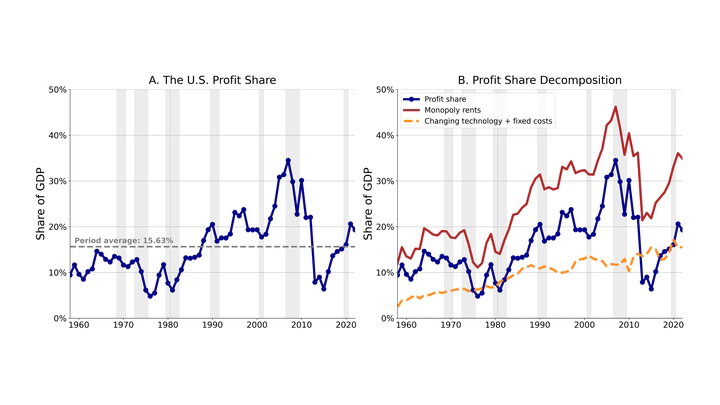
How much has market power increased in the United States in the last sixty years? And how did the rise in market power affect aggregate profits? Using micro-level data from U.S. Compustat, we find that several indicators of market power have increased substantially since 1960. In particular, the aggregate markup has gone up from roughly 10% of price over marginal cost in 1960 to 25% in 2020, and aggregate returns to scale have risen from about 1.03 to 1.15. We develop a micro approach to the aggregate profit share that, unlike the standard macro appraoch treating profits as a residual, constructs it from producer-level data and links aggregate profitability to market power, returns to scale, and production networks. We find that despite the profit share has been constant at 16% of GDP because the rise in market power has been completely offset by rising fixed costs and changes in technology. Using confidential Census of Manufactures data, we further show that labor-market power is an important source of manufacturing profits: in 2017, monopoly and monopsony account for 62 and 38 percent of the manufacturing profit share, respectively.