Abstract
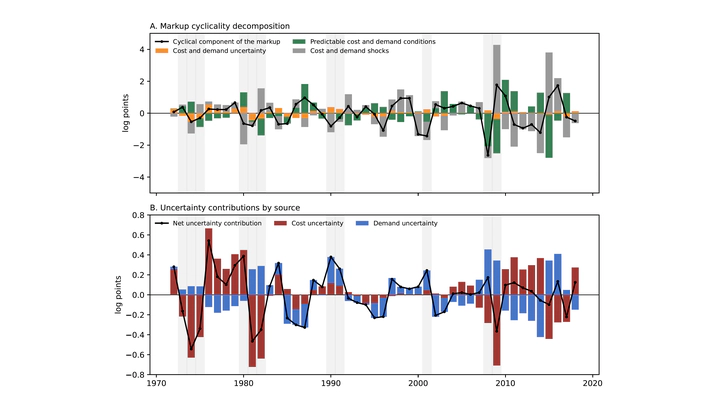
Why are markups cyclical, and why does their cyclicality vary across firms, sectors, and business-cycle episodes? We develop a theory in which risk-averse firms post prices before costs and demand are realized and use prices to manage their risk exposure. Cost uncertainty induces firms to raise prices to limit sales in high-cost states, whereas demand uncertainty induces them to lower prices to support sales in weak-demand states. These opposing responses imply that markup cyclicality depends on the composition and cyclicality of risk, as well as on realized marginal-cost shocks. We test these predictions using U.S. manufacturing data. A one-standard-deviation increase in cost uncertainty raises markups by 1.3 percent, while the same increase in demand uncertainty lowers them by 1.2 percent. Using these estimates, we decompose markup cyclicality and find that realized marginal-cost shocks dominate overall, while uncertainty matters more in earlier business-cycle episodes and recessions. We embed the precautionary-pricing mechanism in a general-equilibrium model of firm dynamics. Eliminating precautionary pricing may appear welfare-improving because lower markups increase allocative efficiency. In general equilibrium, however, it also induces substantial firm exit and reduces product variety, offsetting the welfare gains from lower markups.