Abstract
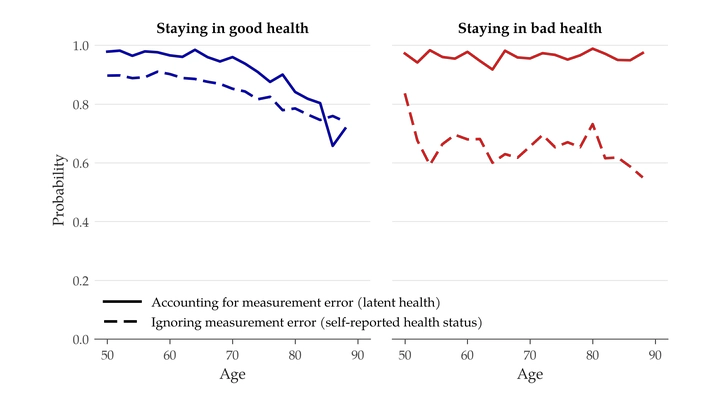
Economists often treat self-reported health as if it perfectly revealed the underlying state. We show that this makes health appear less persistent, attenuates its effects on economic behavior, and can make models seem to require persistent heterogeneity. We estimate a life-cycle model of labor supply and saving on English Longitudinal Study of Ageing data, inferring latent health from noisy indicators and accounting for measurement error throughout structural estimation. Correcting measurement error raises the earnings cost of bad health by 44 percent overall and more than doubles it for the initially unhealthy. These results reflect underestimated health persistence and attenuated labor-supply differences across health states. Without preference heterogeneity or persistent health types, the latent-health model reproduces about 80 percent of the wealth–health gradient, versus about 20 percent when self-reported health is treated as the state. Ignoring measurement error can understate health costs and overstate the apparent need for persistent heterogeneity.